Overview
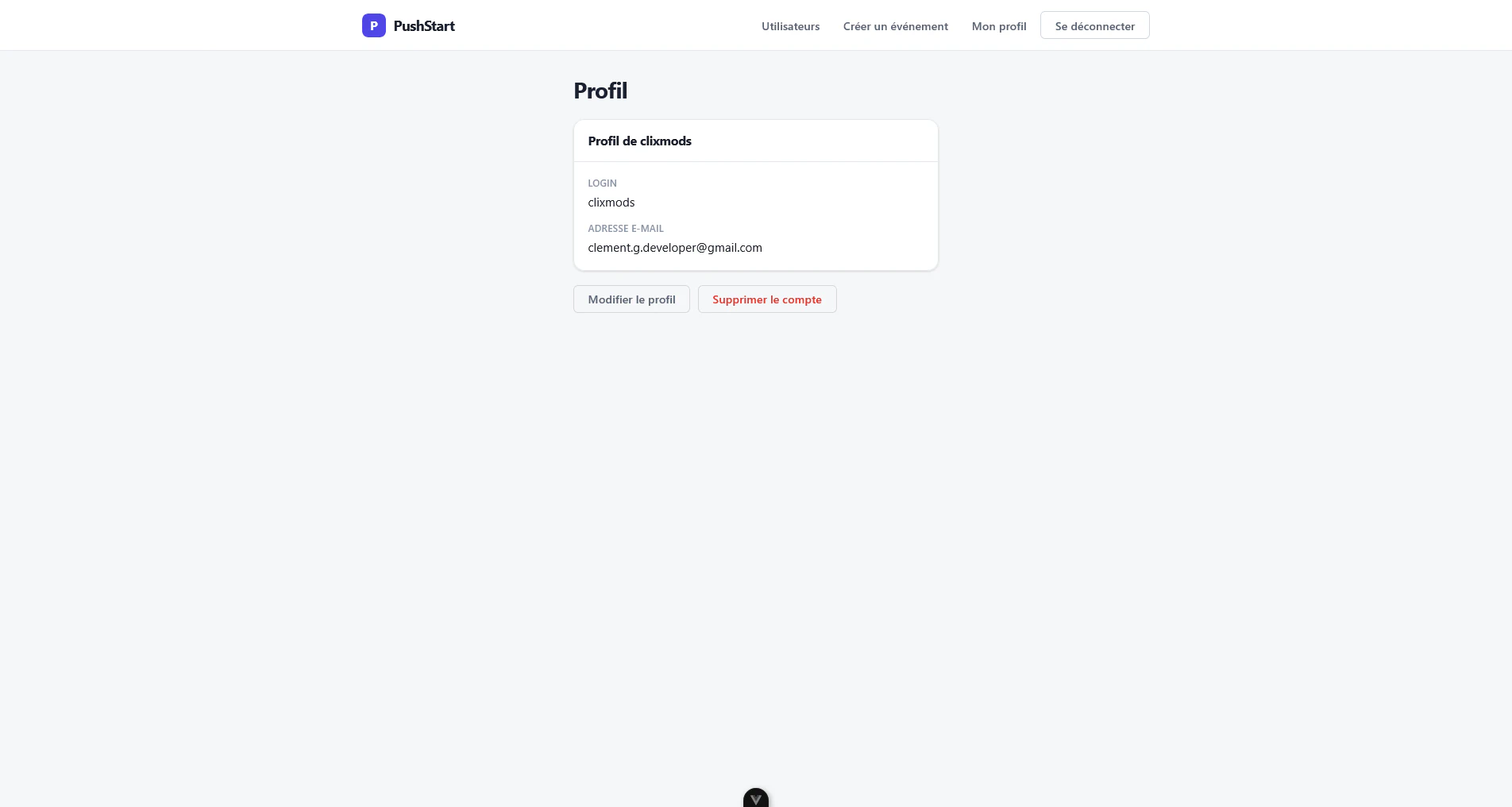
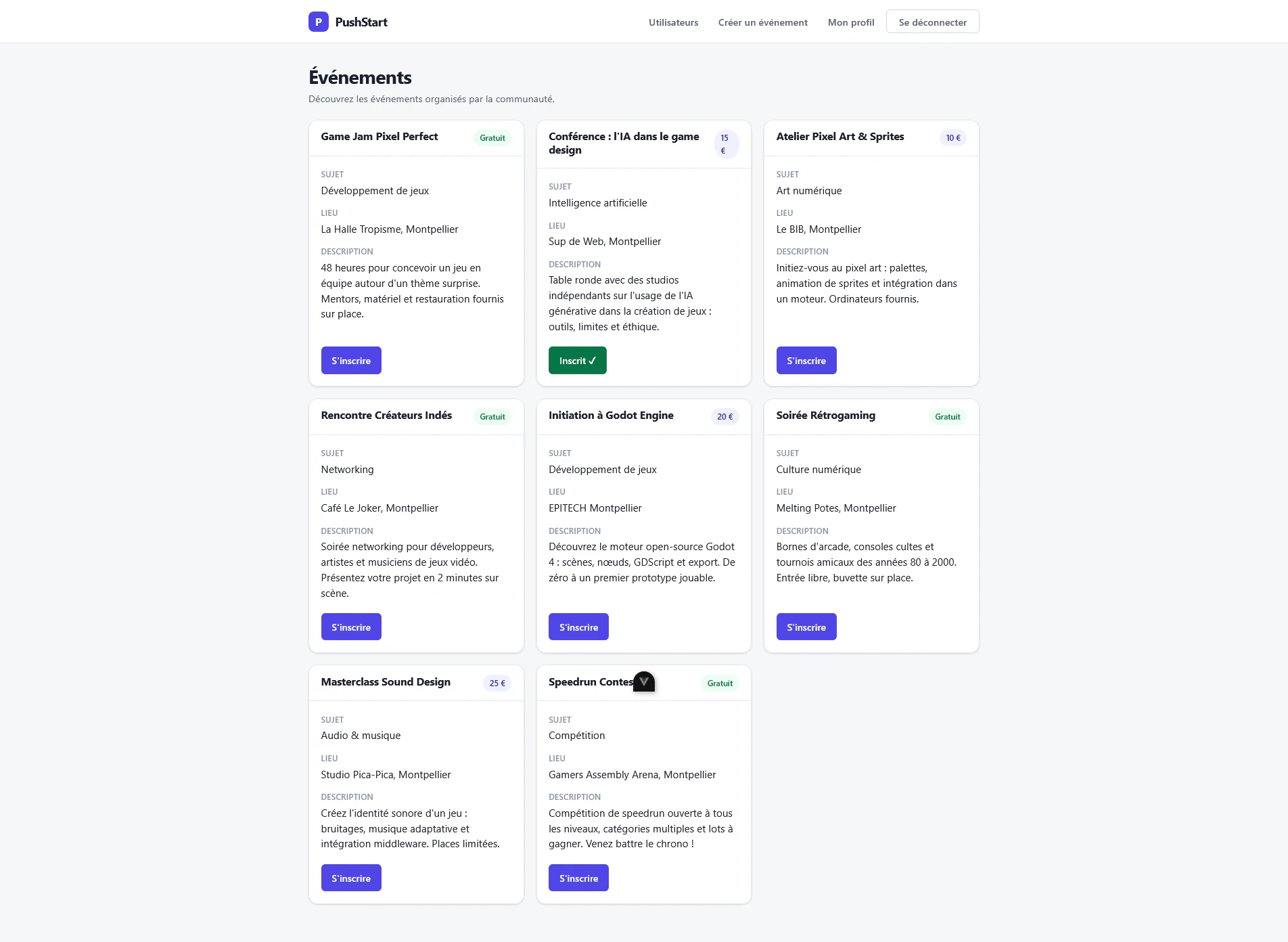
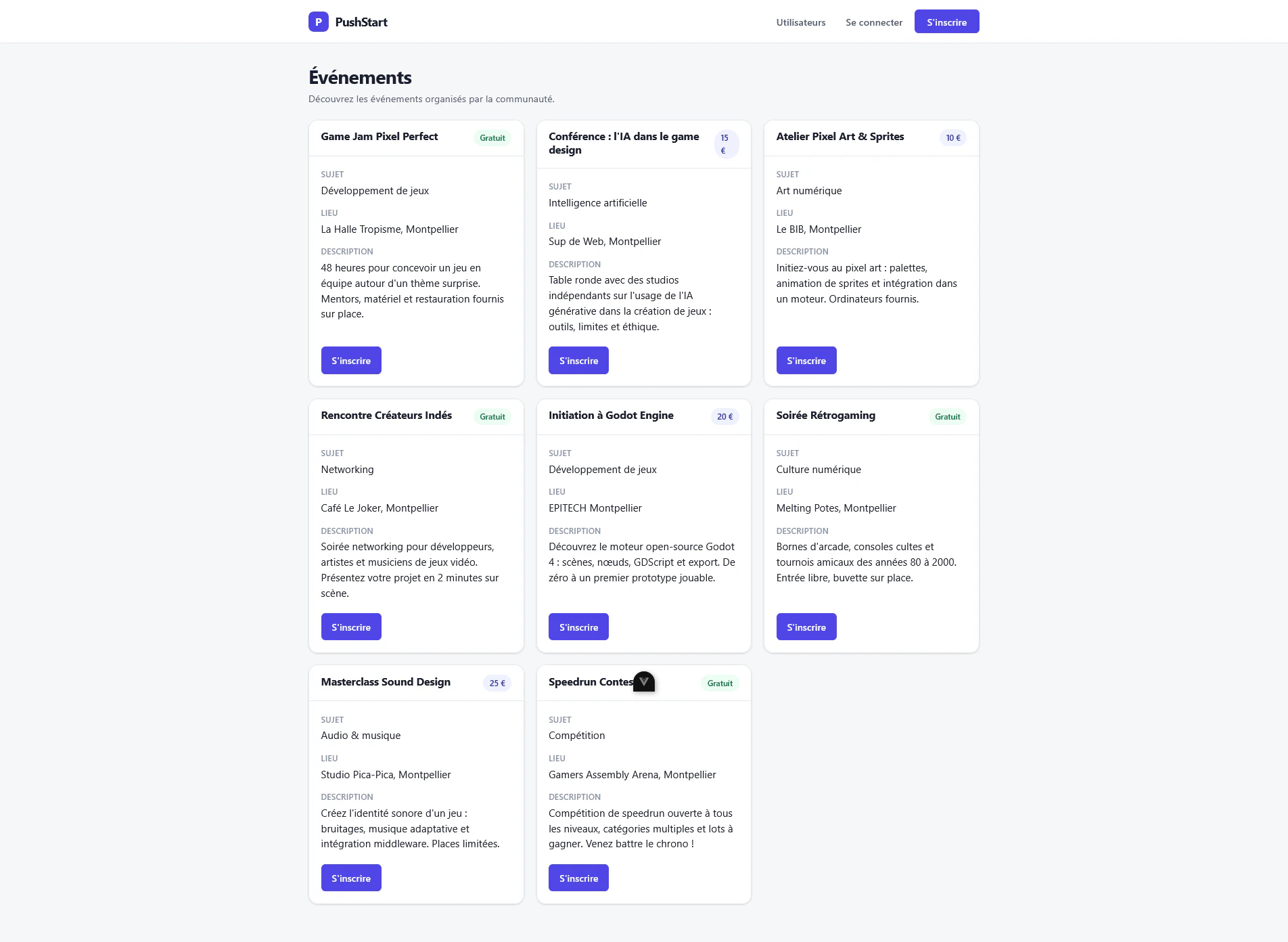
Fifth-semester academic project of the BUT degree, built as a team of three at IUT Montpellier-Sète. The brief was fictional: design a platform allowing an organisation to run its themed events — industry meetups, creative workshops and talks. The application built for the exercise is named Push Start.
The application is built on a decoupled architecture: a REST API developed with Symfony and API Platform on one side, a standalone Vue.js client on the other, communicating solely over HTTP and authenticated with JWT tokens.
- Three distinct roles: attendee, organiser and administrator, each with its own permissions
- Full event lifecycle: creation by an organiser, attendee registration and cancellation, participant listing
- Two months of development split in two phases: API design (October–November), then front-end integration (December)
My role: designing the API
Domain model and business rules
I took ownership of modelling and implementing the business core, built around the Event, Subscription and User entities.
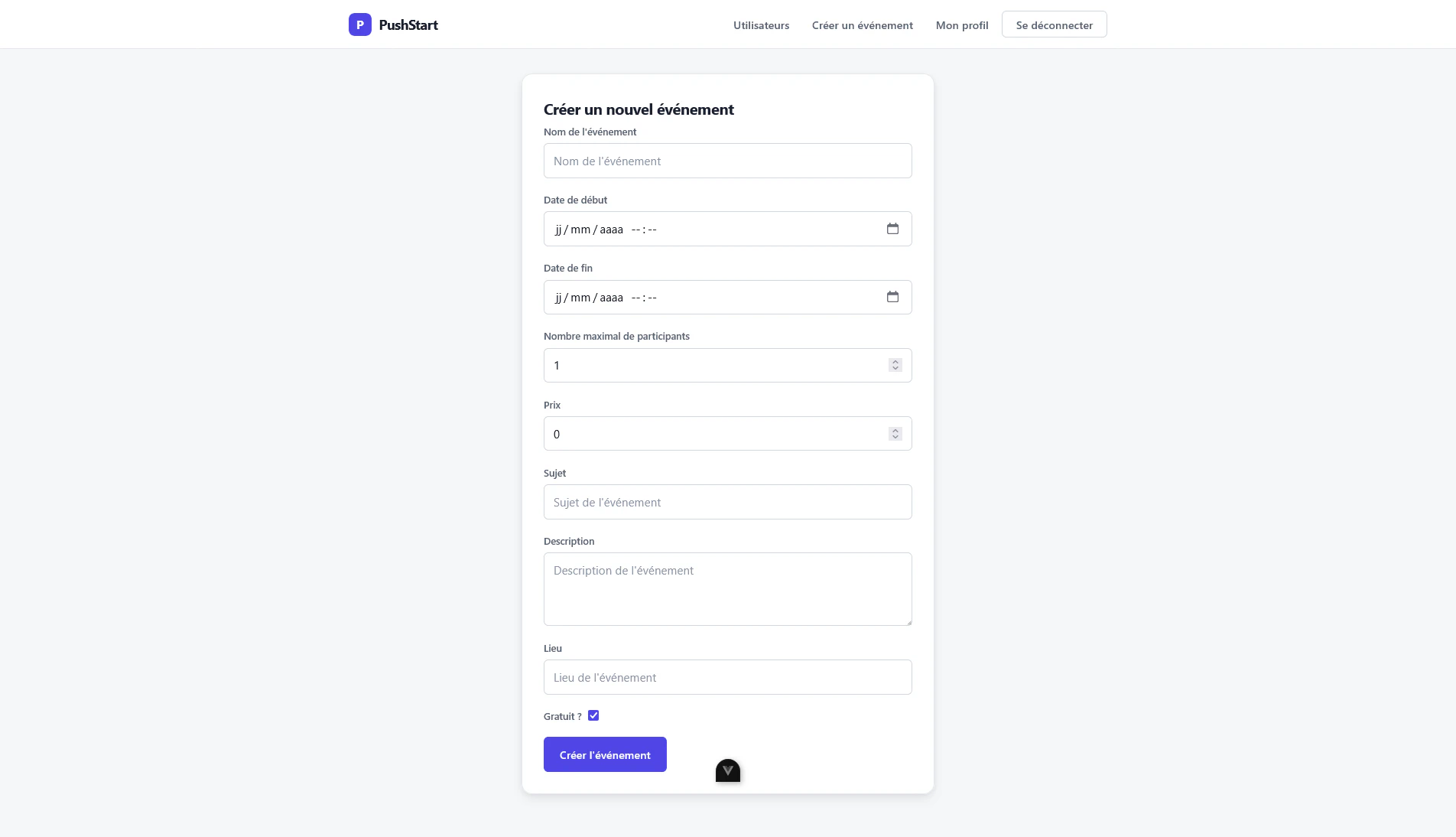
Evententity carrying both general information and theme-specific attributes- Systematic validation on creation: consistent pricing (strictly positive when the event is paid), valid maximum attendee count, and rejection of any date already in the past
- Automatic organiser assignment from the authenticated user, creation being restricted to the
ROLE_ORGANIZERrole Subscriptionentity holding the registration rules: verification that both the user and the event exist, remaining-seat checks, and a ban on registering for two overlapping events- Cascading deletion: removing a user also removes the events they organise
Security and role management
- JWT authentication via LexikJWTAuthenticationBundle, with the token carried in a cookie rather than a header, through a listener on authentication success
- Stateless firewall: no server-side session, the API stays entirely stateless
json_loginentry point on/api/auth, authenticating against theloginfield of theUserentity- Role hierarchy
ROLE_ORGANIZER → ROLE_USER, alongsideROLE_ADMIN - Fine-grained access rules: only the organiser can edit their event, the organiser or an administrator can delete it, and each user manages only their own profile
API Platform and SOLID principles
Rather than concentrating logic inside the entities, each behaviour was isolated in a dedicated class of the API Platform lifecycle — a split that puts single responsibility and dependency inversion into practice.
- Dedicated State Processors:
EventProcessorfor event creation,SubscriptionEventProcessor,SubscriptionPutProcessorandSubscriptionDeleteProcessorfor registrations,UserProcessorfor password hashing SubscriptionProviderState Provider exposing the cross-referenced collections: attendees of an event, events of a userEventAttributeNormalizerapplying conditional serialisation: the organiser decides whether the attendee list is public- Serialisation groups to precisely control which fields are exposed on read and accepted on write
Tooling
create:userconsole command to provision accounts with their roles from the terminal, essential to seed the test database- Versioned Doctrine migrations to rebuild the schema identically
Vue.js front-end — team work
The client side was developed collectively in December; my contribution focused on integration with the API and on keeping the exchange contract consistent.
- Vue 3 in TypeScript, built with Vite, code quality enforced by ESLint and
vue-tsc - Vue Router with routes guarded by user role, restricting certain views to organisers and administrators
- Reusable components for forms (
FormulaireConnexion,FormulaireInscription,FormulaireEvent,FormulaireModification) and data display (BoiteEvent,BoiteUtilisateur) - Centralised API calls in an
apiStore.tsutility module, concentrating JWT handling and error processing instead of scattering them across views
Infrastructure
- Docker Compose orchestrating two services: an Apache server with PHP 8.1, and a MySQL database persisted on a volume
- Local HTTPS through a self-signed certificate and a dedicated Apache configuration
- Vite dev server port exposed by the container, so front-end work never leaves the containerised environment
- CORS handled by NelmioCorsBundle, required as soon as client and API are served from distinct origins
- Reproducible setup in a single command, with database and JWT keys generated through Symfony commands
Teamwork
- A team of three with an explicit split: entities and business rules on my side, user routes and API testing for Victor, JWT and registrations for Téo
- Version control on the IUT GitLab, working on a shared
developbranch, with the repository later mirrored to GitHub - Regular sync-ups and cross-reviews, particularly around permissions, where one member’s decisions directly affect everyone else’s work
- Shared documentation in the README: installation and configuration on my side, routes and database seeding on Victor’s
Technologies
- Back-end: Symfony 6.4, API Platform 4, PHP 8.1, Doctrine ORM 3, LexikJWTAuthenticationBundle 3.1, NelmioCorsBundle
- Front-end: Vue 3.5, TypeScript 5.6, Vite 6, Vue Router 4, ESLint 9
- Infrastructure: Docker Compose, Apache, MySQL
What I took away
- Designing a stateless API changes how you think about authentication: everything has to fit in the token, nothing can rely on a session anymore
- API Platform’s processor split makes SOLID principles tangible — every business rule gets its own file, and entities stay readable
- A decoupled architecture demands a clear contract between the two halves of the team: the slightest ambiguity in a response format is paid for immediately on the client side